DAO and Security
Outline
- Data Access Object
- Why persist data?
- What is a DAO?
- DAO Example
- Computer Security
- Definition
- Security vulnerabilities
- SQL Injection
- Password Management
- Authentication with cipher
- Password hashing
- Example
We will start by talking about data storage.
Data Access Object (DAO)
Our goal is to store data, but first:
A Computer
What are its main components?
- A processor (CPU): does ONLY calculations
- RAM: fast, volatile memory
- Hard drive (HDD, SSD): long-term memory
- Graphics card: specialized processing unit
Emphasize CPU, RAM, and hard drive! They provide three different services: - CPU: processor - HDD: disk - RAM: memory modules
How to Solve This Problem?

What problem??
Answer: Retaining data after the Python program ends.
A Question to Ask
p = Personnage(prenom="Leia", nom="Organa", age = 35)What is a Python variable?
- A reference (the variable name)
- An associated object (its value)
- We skip the concept of memory addressing.
- No need to store the reference, as it is in the source code.
A Follow-Up Question
personnage.py
class Personnage:
    def __init__(self, prenom, nom, age):
        self.prenom = prenom
        self.nom = nom
        self.age = age
        self.vaisseaux = []
    def anniversaire(self):
        self.age += 1
What is a Python object?
- Attributes (which can themselves be objects)
- Methods
Same thing, methods are code, we only want the attributes.
In Summary
- We want to save key-value pairs
- With values that can themselves consist of key-value pairs
- Need a drawing with Leia and Vaisseaux
- Parallel with Python dicts / JSON
- Tree because object attributes are sometimes themselves objects.
How to Do This?
- Write our data to a hard drive in a file
- csv, parquet, json, xml
- Use a database
- SQL tables + relations, NoSQL
Question: How does a database work?
- It manages files
- We can make a parallel with layers
- The database provides a service, I ignore how it does it
- I know what it expects as input and what it gives me as output!
Link Between Persistence and Application
- Python: Volatile variables in RAM
- Persistence system: Data stored on disk
- Data Access Objects (DAO) as a link
- Short recap to try to get everyone back on track before DAO.
- In real life, we don’t start from scratch when relaunching an app.
- If you create a Personnage, the next time it will still be there.
What is a DAO?
- We just said we will store in a database.
- How to access it?
What is a DAO?
- Technical class
- One DAO class per business object
- Exposes methods to communicate with the persistence layer
It’s an API
Provides a service to clients
How it does it? -> Don’t care
Like you in a restaurant. You want to eat, how it’s made doesn’t matter as long as the service is provided (with a certain level of expectation).
ORMs like SQLAlchemy exist to link Python Objects - Database Tables -> not the subject here.
Which Methods to Expose?
- Create
- Read
- Update
- Delete
Get participation
Try to show that these four are sufficient.
Later we can have refinements by doing things in bulk or filtering, etc.
What about copying?
A copy is a read + creation, so we know how to do it.
Example drawing: Person class - person table - personDAO class.
The Benefit of a Separate Class
Separation of responsibilities
- “Disposable” class 🚮
- Modifiable without risk 🔨
- Parallel work 🦸♀️🧙♂️👨💼👩🔬
- We add another layer, it doesn’t hurt.
- In real life, if the system changes, it’s easier to migrate.
- In the project, the DAO layer can be very easy to do.
Quick Recap
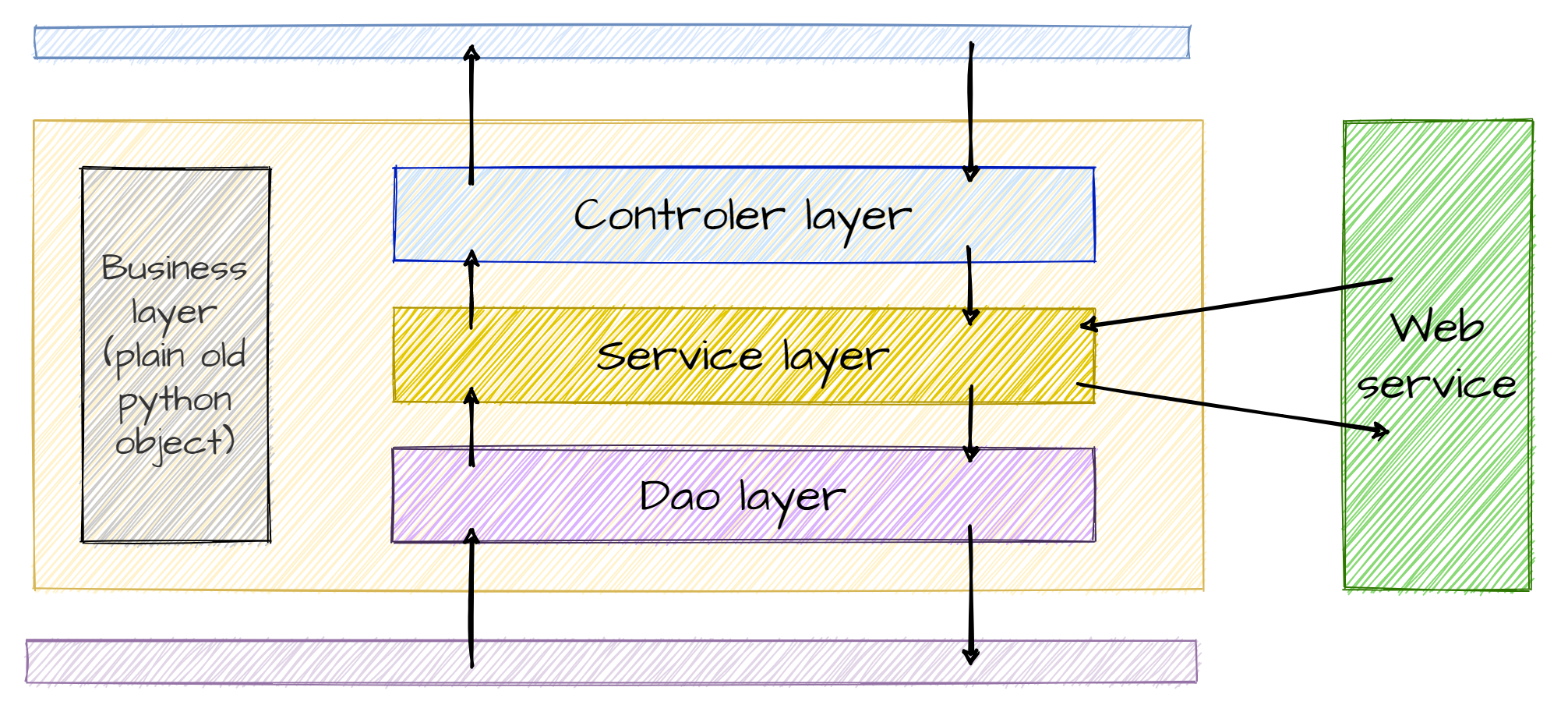
- Small example to illustrate.
- Example: list all people who are fans of Pokemon.
How to Connect to a Database in Python?
Use a dedicated library
- PostgreSQL: psycopg2
- MySQL: mysql-connector-python
- Oracle: cx_Oracle
- MongoDB: pymongo
- You will read the entire psycopg2 documentation.
- There will be questions on the exam!
psycopg2
pip install psycopg2-binaryconnection: Establishes the connection to the database Not super interesting to do, the code is provided
psycopg2 - Connection
db_connection.py
import os
import dotenv
import psycopg2
from psycopg2.extras import RealDictCursor
from utils.singleton import Singleton

class DBConnection(metaclass=Singleton):
    """
    Database connection class
    It allows opening only one unique connection
    """
    def __init__(self):
        """Open the connection"""
        dotenv.load_dotenv()
        self.__connection = psycopg2.connect(
            host=os.environ["POSTGRES_HOST"],
            port=os.environ["POSTGRES_PORT"],
            database=os.environ["POSTGRES_DATABASE"],
            user=os.environ["POSTGRES_USER"],
            password=os.environ["POSTGRES_PASSWORD"],
            options=f"-c search_path={os.environ['POSTGRES_SCHEMA']}",
            cursor_factory=RealDictCursor,
        )
    @property
    def connection(self):
        return self.__connection
Singleton
psycopg2 - Cursor
cursor: Encapsulates the queryfrom dao.db_connection import DBConnection with DBConnection().connection as connection: with connection.cursor() as cursor:cursor.execute("<a SQL query>"): Executes a querycursor.fetchone()/fetchall()/fetchmany(): Retrieves the results
Basic Form
def dao_function(self, arg1, arg2, ...):
    # Get the database connection
    with DBConnection().connection as connection:
    # Create a cursor to make a query
        with connection.cursor() as cursor:
            # Send the SQL query to the server
            cursor.execute(
                "<a_sql_query_with_placeholders>",
                fill_in_the_placeholders)
            # Retrieve the query result
            res = cursor.fetchone()  # or fetchall()/fetchmany()
    # If the query returns something
    if res:
      something = "<res formatted>"

return something- Why don’t we return res directly?
- res: list[dict]
- We prefer to return an Object or a list[Object]
A Small Example: LivreDao
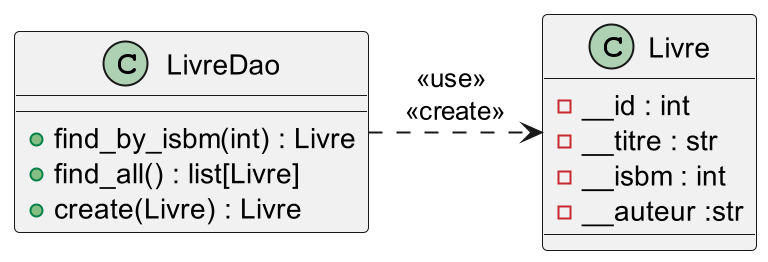
ISBN: International Standard Book Number
Create a Book
def create(self, livre) -> Livre:
    """To create a book in the database"""
    with DBConnection().connection as conn:
        with conn.cursor() as cursor:
            cursor.execute(
                "INSERT INTO livre (isbm, titre, auteur)         "
                "     VALUES (%(isbm)s, %(titre)s, %(auteur)s)   "
                "  RETURNING id_livre;                           ",
                {"isbm": livre.isbm,
                 "titre": livre.titre,
                 "auteur": livre.auteur},
            )
            livre.id = cursor.fetchone()["id_livre"]
    return livre
It’s also possible to return a boolean:
- true if creation is successful
- false otherwise
List Books
def find_all(self) -> list[Livre]:
    """To retrieve all books from the database"""
    with DBConnection().connection as conn:
        with conn.cursor() as cursor:
            cursor.execute(
                "SELECT id_livre,                  "
                "       isbm,                      "
                "       titre,                     "
                "       auteur                     "
                "  FROM livre ;                    "
            )
            livre_bdd = cursor.fetchall()

    liste_livres = []
    if livre_bdd:
        for livre in livre_bdd:
            liste_livres.append(
                Livre(
                    id=livre["id_livre"],
                    isbm=livre["isbm"],
                    titre=livre["titre"],
                    auteur=livre["auteur"],
                )
            )

return liste_livres- livre_bdd = [{id_livre=1, isbm=123, “Le Schtroumpf hackeur”, “Peyo”}, {…}, …]
- livre = {id_livre=1, isbm=123, “Le Schtroumpf hackeur”, “Peyo”}
- liste_livres = [Livre(1, 123, “Le Schtroumpf hackeur”, “Peyo”), Livre(…), …]
Find a Book
def find_by_isbm(self, isbm) -> Livre:
    """To retrieve a book by its isbm"""
    with DBConnection().connection as conn:
        with conn.cursor() as cursor:
            cursor.execute(
                "SELECT *                          "
                "  FROM livre                      "
                " WHERE isbm = %(isbm)s            ",
                {"isbm": isbm}
            livre_bdd = cursor.fetchone()

    livre = None
    if livre_bdd:
        livre = Livre(
            id=livre_bdd["id_livre"],
            isbm=livre_bdd["isbm"],
            titre=livre_bdd["titre"],
            auteur=livre_bdd["auteur"],
        )
return livre- livre_bdd: dict
- livre: Livre
- Principle to remember if you want to understand: in DAOs, we always transform dicts into objects.
Conclusion
- Python works in RAM (volatile)
- Need a mechanism for data persistence
- DAO: centralizes methods for reading/writing our data
- The business layer calls the DAO without worrying about the persistence system
- Enables effective teamwork 🦸♀️🧙♂️👨💼👩🔬
Computer Security
CIA Principles

3 Pillars of Computer Security
- Confidentiality,
- Integrity
- Availability
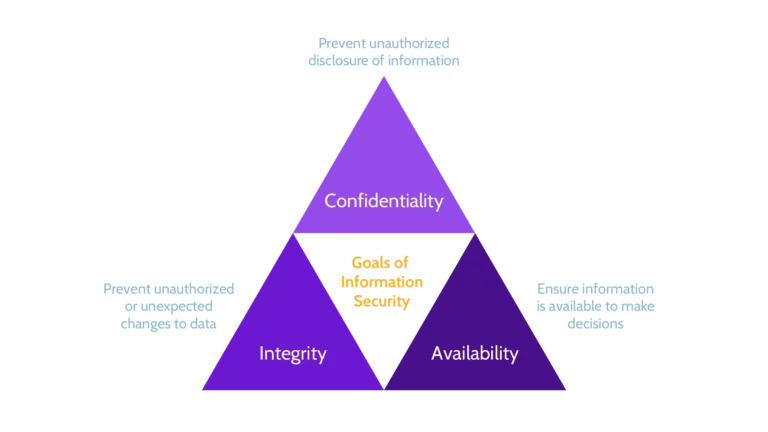
Sometimes we also use CAID, DICP or DICPA in French Availability, Integrity, Confidentiality, Proof
Plus 2
- Authenticity (or Proof)
- Non-repudiation
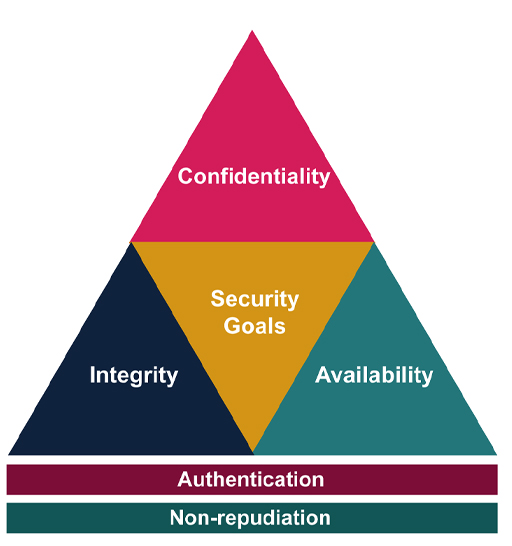
Confidentiality
Associated Mechanisms:
- Rights management (directories, roles, etc.)
- Cryptography
We talk more about encryption.
Integrity
Associated Mechanisms:
- Digital signature
- Checksum
Digital signature: Ensures the integrity of a document, i.e., ensures that the document has not been altered between its signing and its consultation; authenticates its author, i.e., ensures the identity of the signing person. Checksum: Parity bit.
Availability
Associated Mechanisms:
- Server redundancy
- Virtualization
- Containerization
Backup Talk about deployment beforehand.
Traceability
Associated Mechanism:
- Logging
Logs (better than prints) Project 2024-2025
Authentication
Associated Mechanisms:
- Weak authentication (identifier, password)
- Strong authentication (biometric data, multi-factor)
Non-repudiation
Associated Mechanisms:
- Traceability
- Authentication
- Integrity
It wasn’t me But it’s your name! Don’t leave your sessions open during breaks (CTRL + ALT + F12)
Computer Security Vulnerabilities
Too Many Vulnerabilities!!!
- Low-level physical vulnerabilities
- High-level physical vulnerabilities
- SQL Injection
- Data injection
- XSS Vulnerability
- Code execution
- …
- Low-level physical vulnerabilities: power outage, server room flooding
- High-level physical vulnerabilities: physical access to a machine
What Should You Be Wary Of?

Your users
Example of Vulnerabilities: SQL Injections
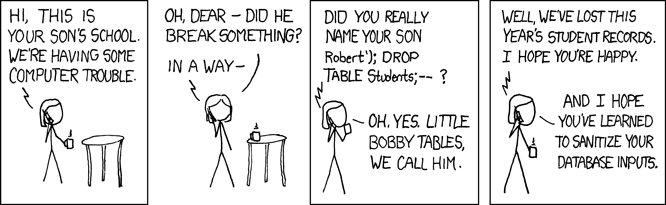
Source: https://xkcd.com/
SQL Injection
Involves entering SQL to execute a different query than intended.
Problems:
- Confidentiality
- Authentication
- Integrity
- Availability
Example: Authenticating Without a Password
Authentication query
SELECT *
  FROM user
 WHERE name = 'input_name'
AND password = 'input_password';- Gennysson
- awesome_password
SELECT *
  FROM user
 WHERE name = 'Gennysson'
   AND password = 'awesome_password';
If your cursor.execute contains this code
Example: Authenticating Without a Password
SELECT *
  FROM user
 WHERE name = 'input_name'
AND password = 'input_password';- Gennysson
' OR 1=1; --
SELECT *
  FROM user
 WHERE name = 'Gennysson'
   AND password = '' OR 1=1; --';
Example: Deleting a Table
SELECT *
  FROM user
 WHERE name = 'input_name'
AND password = 'input_password';- Gennysson
'; DROP TABLE user CASCADE; --
SELECT *
  FROM user
 WHERE name='Gennysson'
   AND password=''; DROP TABLE user CASCADE; --;
How to Protect Yourself?
- Escape special characters
- Use a prepared query
The library you use only escapes special characters 😨
A prepared query :

The second solution is better than the first, but psycopg2 doesn’t seem to offer it simply.
So you need to know it, but know that it’s the first solution that will be used.
Escaping special characters: for example, ” ’ ” will be replaced by ” ' ”
The apostrophe will therefore not be interpreted as an end of string by the DBMS. “prepare” instruction:
- Sends the query with placeholders to the database
- Sends to fill in the placeholders
Cross-Site Scripting
Involves injecting code that causes actions on the browser. This can allow:
- Page redirections (phishing)
- Information theft
- Actions on the site
- Making the site difficult to use
How to Protect Yourself?
- Never insert raw data
- Escape special characters
- Verify your data
Web libraries often do this for you!
To Sum Up: Injection
Never trust user inputs, verify/clean them
Never trust user inputs, verify/clean them
Never trust user inputs, verify/clean them
NEVER TRUST USER INPUTS
USERS ARE YOUR N°1 VULNERABILTY
USERS ARE THE DEVIL
Password Management
To test the strength of a password:
Should Your Application Store Plain Text Passwords?

Does Your Application Need to Know a User’s Password to Authenticate Them?

How Do We Do It?

Hashing the Password
- Hash the password
- Store the hash in the database
- When you need to compare, hash the entered password
- And compare the hashes
Authentication without persisting passwords!!!!
It’s so simple and secure!
But not all sites do it…
A site that sends you your password keeps it in memory (or at least the means to decrypt it).
In real life, we add a “salt” to the password before hashing it.
It’s a random value calculated for each user that we add to the password before hashing it.
This makes a brute force attack more costly.

Add Salt for More Security

A Database Without Added Salt
- Your email/password database leaks, but the passwords are hashed
- Attackers must brute-force the passwords
- They start with the most common passwords and hash them with common hash algorithms
- Then they compare with the database
- High chance of having several matches (cf : USERS ARE THE N°1 VULNERABILITY)
Brute-force: testing all possible combinations.
Salt is Good for Security
Instead of hashing and storing the password
Store and hash the password,
AND an element linked to the user in a deterministic way (the salt).
Now even if two people have the same password, they will have different hashes.
Salt is Good for Security
- Your email/password database leaks, but the passwords are hashed and salted
- Attackers must brute-force the passwords
- They start with the most common passwords and hash them with common hash algorithms
- Then they compare with the database.
- There are no matches because your passwords are salted
- And finding one password doesn’t allow finding others
Example of Password Hashing
import hashlib

def hash_password(password, idep):
    salt = idep
    return hashlib.sha256(salt.encode() + password.encode()).hexdigest()

print(hash_password("awesome_password", "Gennysson"))
To Sum Up the Security Part
- Always verify inputs
- Never trust users
- Multiple levels of security
- No need to store plain text passwords
Honest version :
- Always assume your users are either hackers or idiots with no self preservation instincts
- Always know you are less smart than you think : you-proof the system
- Assume your colleagues are as just smart as you : wrap their security in your security
- For the love of all that is good in the world, do NOT store sensitive identifying information in clear (use your data science instincts)