Development Tools
Development Environment
- Practical exercises and projects completed on a Datalab
- Can also be done on the VM (backup)
Datalab stack
Visual Studio Code: your code editorPython 3.13Git: to manage your repositoriesPostgreSQL: a databasecloudBeaver: for viewing and editing this database
What’s on your school VM?
Python 3.10: Python version chosen by ENSAIVisual Studio CodeGitPostgreSQLDBeaver: database administration tool to consult or edit
Visual Studio Code
- Widely used and known code editor
- Includes a file navigator and a terminal
- Many (many many) extensions
- Customization
Focus on Settings
.vscode/settings.json
{
  "workbench.colorTheme": "Dark Modern",
  "editor.fontSize": 16,
  "[python]": {
    "editor.formatOnSave": true,
    "editor.insertSpaces": true,
    "editor.tabSize": 4,
    "editor.defaultFormatter": "charliermarsh.ruff",
  },
  "ruff.lint.enable": true,
  "files.exclude": {
    "**/__pycache__": true,
    "**/.pytest_cache": true,
  }
}- Montrer le fichier settings.json (DEMO)
- icone ⚙️ niveau workspace ou user
- à priori vous n’avez rien à modifier
- vous pouvez intégrer ce fichier dans votre dépôt projet
- Formater et Linter en phase
Formater :
- Ligne trop longue
- Espaces superflux
Code Quality
What is “quality” for code?
- Maintenance: easier to understand, maintain, and change/improve
- Readability: reduces errors and makes collaboration easier
- Performance: works better, faster, with fewer resources
- Security: less vulnerable and susceptible to exploits
Pylint
A static analysis tool for Python that:
- Checks code compliance with style standards
- Detects potential errors
- Identifies bad practices
Commands
pylint src
pylint --output-format=colorized --disable=C0114,C0411,C0415,W0718 $(git ls-files '*.py') --fail-under=7.5- You can disable rules that bother you
- Do this regularly
Repository Structure (Root)
PROJET-INFO-2A
    ├── .vscode/settings.json
    ├── backend
    ├── data
    │   └── init_db.sql
    ├── doc
    │   ├── tracking
    │   |   └── YYYY.MM.DD-semaineN.md
    │   └── report
    ├── frontend
    ├── .gitignore
    ├── LICENCE
    └── README.md
2 projet en 1 repo :
- backend -> API (voir ci-après)
- frontend -> Interface (voir TP5)
Repository Structure (Backend)
backend
    ├── src
    │   ├── business_object
    │   │   └── une_classe.py
    │   ├── controller
    │   │   └── une_classe_controller.py
    │   ├── dao
    │   │   └── une_classe_dao.py
    │   ├── service
    │   │   └── une_classe_service.py
    │   └── utils
    ├── tests
    │   ├── test_dao
    │   └── test_service
    ├── README.md
    └── pyproject.toml
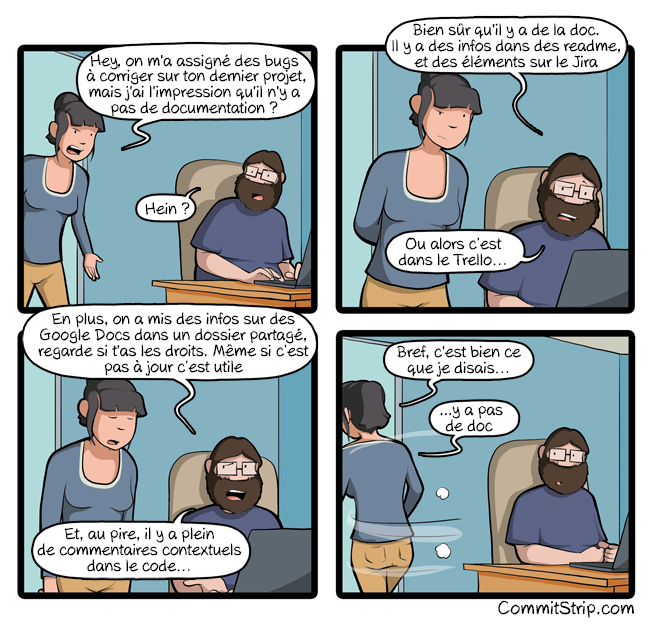
Documentation
mathematical_operations.py
class MathematicalOperations:
    """Mathematical Operations"""
    def divide_five_by(self, number) -> float:
        """Divides the number 5 by a given number.
        Parameters
        ----------
        number : float or int
            The number by which 5 will be divided.
        Returns
        -------
        float or None
            The result of dividing 5 by the given number.
            If the number is equal to 0, the method returns None.
        """
        if number != 0:
            return 5 / number
        else:
return None- Document classes
- Attributes
- Document methods
- Brief description
- Parameters
- Return
mypy ?
README.md
- Presentation
- Quick start
- How to use
README qui veut dire …
Un bon README = vos grands-parents sont capables de lancer l’appli
markdown : balisage (quarto, notebook)
Logs
What are logs?
Note
Logging is the process of recording events, errors, and information in an application.
A log captures information about what happened at a given time:
- Monitoring
- Debugging
- They allow monitoring the state of a system, unexpected behaviors
- They help identify and resolve issues
Level 1 - Beginner
- You have an error in your code
- But you don’t know exactly where?
- What do you do?
You put “prints” everywhere
Level 2 - Debug Mode
- You add a breakpoint
- You launch in debug mode
- You proceed until the error
Demo
Level 3 - Logs
import logging
logging.basicConfig(
    filename='logs/example.log',
    level=logging.INFO,
    format="%(asctime)s - %(levelname)-8s - %(message)s",
    datefmt="%d/%m/%Y %H:%M:%S")
It is possible to externalize the configuration in a logging_config.yml file
logger.debug("This is a debug message")
logger.info("This is an info message")
logger.warning("This is a warning message")
logger.error("This is an error message")
Log Levels
- DEBUG: useful for debugging during development
- INFO: tracking executed code
- WARNING: unusual but non-blocking situation
- ERROR: affects program logic but doesn’t stop it completely
- CRITICAL: requires urgent intervention
A Good Start
import logging
def my_method(a):
    logging.debug("my_method - START")
    ...
    logging.debug("my_method - END")
You will have something looks like :
- Method a ➡️ call method b ➡️ call method c, d …
It’s good to know where the code crashed.
Going Further
Use the modules:
- src/utils/log_init.py
- src/utils/log_decorator.py
And add a @Log decorator before each method
Wrapper: will encapsulate the method Demo log_decorator