Unit Testing
Testing
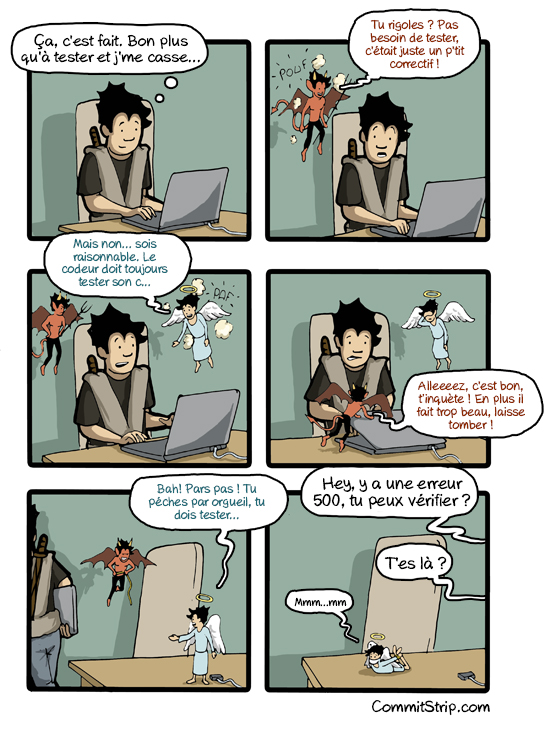
Source : CommitStrip
Why Test?
- Car crash tests
- Compliance tests
- Quality tests in industry
- Statistical tests
In Computer Science
- To verify that your program works
- To detect errors
- To avoid regressions (when you modify code)
Note
No test is perfect, but it still helps eliminate many errors.
Definition
A test resembles a scientific experiment.
It examines a hypothesis expressed in terms of three elements:
- Input data
- The object to test
- Expected results
This examination is conducted
- under controlled conditions
- with the goal to draw conclusions
- and ideally, be reproducible.
Test Coverage
- Percentage of functions tested
- ONE quality indicator
- Trend, rather than a reliable value
Be lazy : fewer tests, but useful ones!
Types of Tests
There are many different types of tests, here are the main ones:
- Unit test
- Functional test
- Load test
- Integration test
- Penetration test
Unit Testing
We will use the pytest package to perform our tests in Python.
A Good Unit Test
- Tests a single functionality
- Isolated
- Reproducible
- Deterministic
Method to Test
operations_mathematiques.py
class MathOperations:
    """Mathematical Operations"""
    def divide_five_by(self, nb) -> float:
        """Divides the number 5 by a given number.
        Parameters
        ----------
        nb : float or int
            The number by which 5 will be divided.
        Returns
        -------
        float or None
            The result of dividing 5 by the given number.
            If the number is equal to 0, the method returns None.
        """
        if nb != 0:
            return 5 / nb
        else:
            return None
Test Class
Let’s create a test class.
To test the nominal case (=“normal” case), we:
- Choose an input number
- Call the
divide_five_by()method - Verify that the returned value is equal to the expected value
Nominal Case
Other Cases
But this is not sufficient!
- The method also has another possible return:
None - We also need to test this case
What If…
We call the method with this parameter: divide_five_by("a")?
You can also write a test to verify that your method indeed returns a TypeError exception in this case.
Key Takeaways
Unit tests:
- Verify that a method does what it is supposed to do
- Test nominal cases, but also edge cases and errors
- A unit test tests ONE and ONLY ONE thing
- As many unit tests as there are possible returns
Mock
- Simulated object that replaces a real component during tests
- Isolating external dependencies = test code independently
- Simulate complex scenarios like network errors
Mock - Example
player_service.py
Mock - Example
test_player_service.py
from unittest.mock import MagicMock
def test_create_ok():
    """Successful creation of Player"""
    # GIVEN
    pseudo, mdp, age, mail, fan_pokemon = "jp", "1234", 15, "z@mail.oo", True
    PlayerDao().creer = MagicMock(return_value=True)

    # WHEN
    player = PlayerService().creer(pseudo, mdp, age, mail, fan_pokemon)

    # THEN
    assert isinstance(player, Player)
assert player.pseudo == pseudoTest-Driven Development (TDD)
When to Test?
At the beginning!
Tip
The earlier you test, the more effective and less costly the tests are!
Test-Driven Development
The best practice:
- Create the tests
- Code the function
Logic
It may seem a bit strange !?
But…
When you code a function, you know before you start:
- What the input parameters will be
- What results you expect as output
- So you already know what to test!
TDD Practice
- ✅ Improvement of code quality
- ✅ Reduction of bugs
- ❌ then ✅ Time
- ❌ Maintenance of tests
Important
Advantages >>> Disadvantages
Project tip
Designate the Test Police (or the Quality Police)
Why ?
- Ensure all important methods are tested
- Maintain consistency in testing and documentation
- Promote the test-first thinking
Benefits on team spirit
- Contribute to code quality without coding A-Z
- One person has an idea of the whole architecture and the pain points
- Easier to review when it’s not your code