Advanced Object-Oriented Programming
Outline
- Advanced OOP Concepts
- Recap
- Abstract Classes
- Bridge Pattern
- Software Engineering
- Definition
- Single Responsibility Principle
- Design Patterns
A Few Reminders
The three principles of object-oriented programming:
- Encapsulation: an object contains attributes and methods.
- Inheritance: an object can inherit attributes and methods from another class to redefine them. It can also add other attributes/methods.
- Polymorphism: a method can be associated with different code depending on the parameters passed or the object it belongs to.
An Example to Illustrate
Automatic data processing application:
- Multiple data sources: surveys, web scraping, administrative files, etc.
- Multiple data formats: csv, xml, json, etc. (we’ll come back to this)
- Multiple processing algorithms: exploratory statistics, regression, “machine learning,” etc.
Example of a Class Diagram
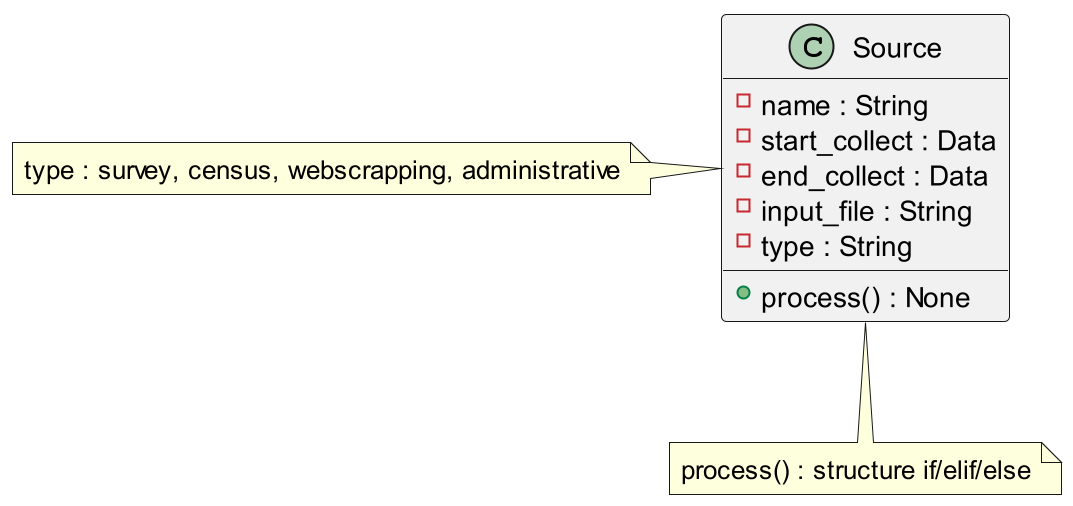
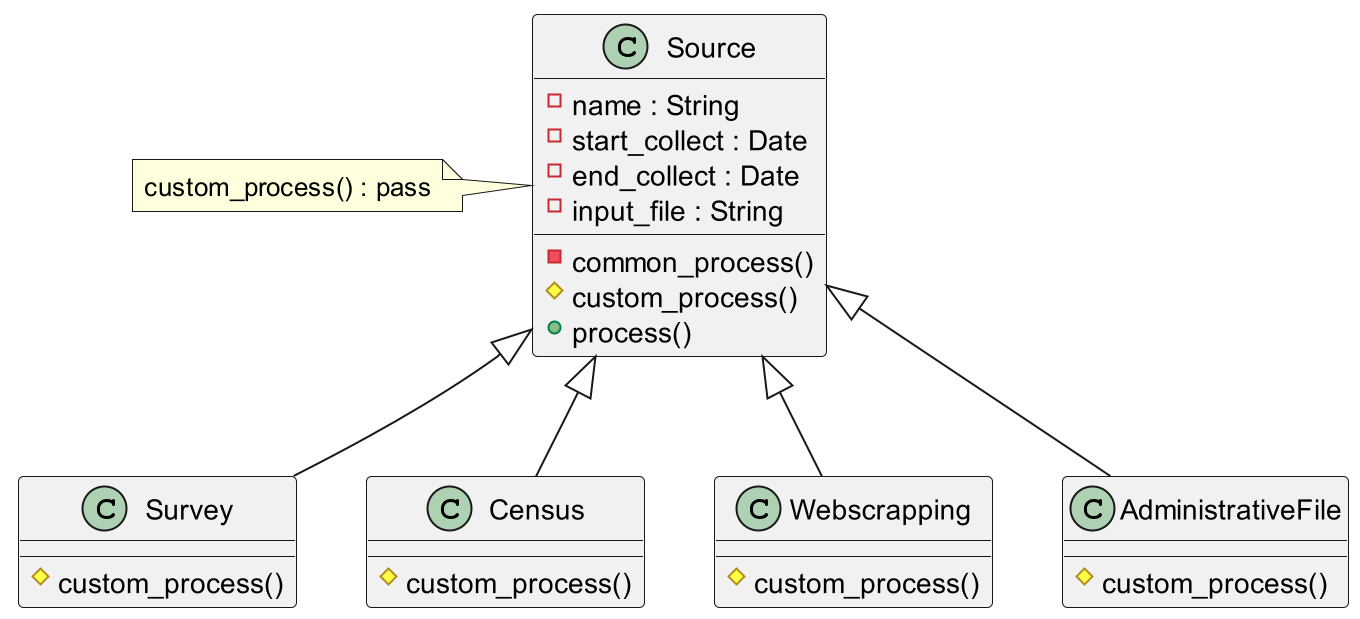
An Example with Inheritance
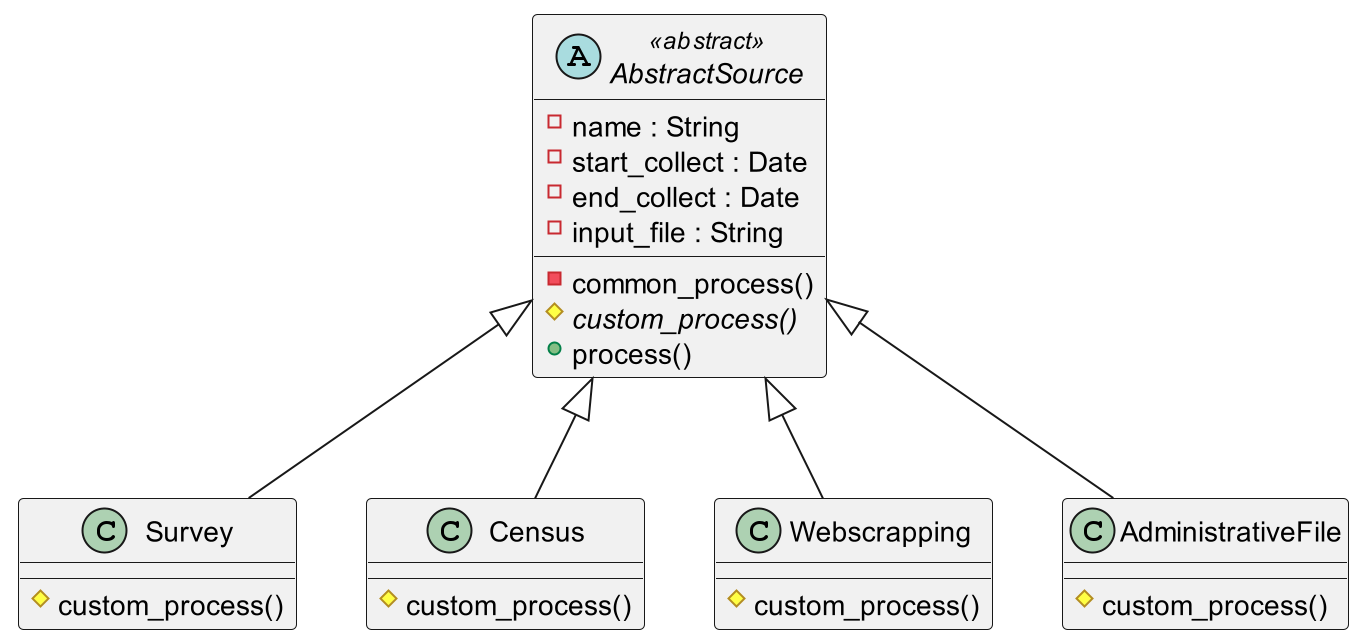
Abstract Classes
Abstract Class: a class whose implementation is not complete and which is not instantiable.
Allows passing a contract. Child classes will have to implement what is missing.
Advantages:
- We know what child classes must do 👍
- We can generate code 🙏
- Limits the risk of error!! 👌
For Example
And in Python?
- No native support for abstract classes 😱
- Abstract Base Classes (abc) module to solve the problem 🦾
- Already included in your Python distribution 😌
- Step 1: Import the module 🧳
- Step 2: Inherit from
ABC👨👩👧👦 - Step 3: Define abstract methods 📝
- Step 4: ???
- Step 5: Profit 💰💰
What If We Added Data Formats?
Currently, 3 data formats in our application:
- CSV: Comma Separated Values (tabular)
- XML: eXtended Markup Language (tag format)
- JSON: JavaScript Object Notation (key-value format)
For Example
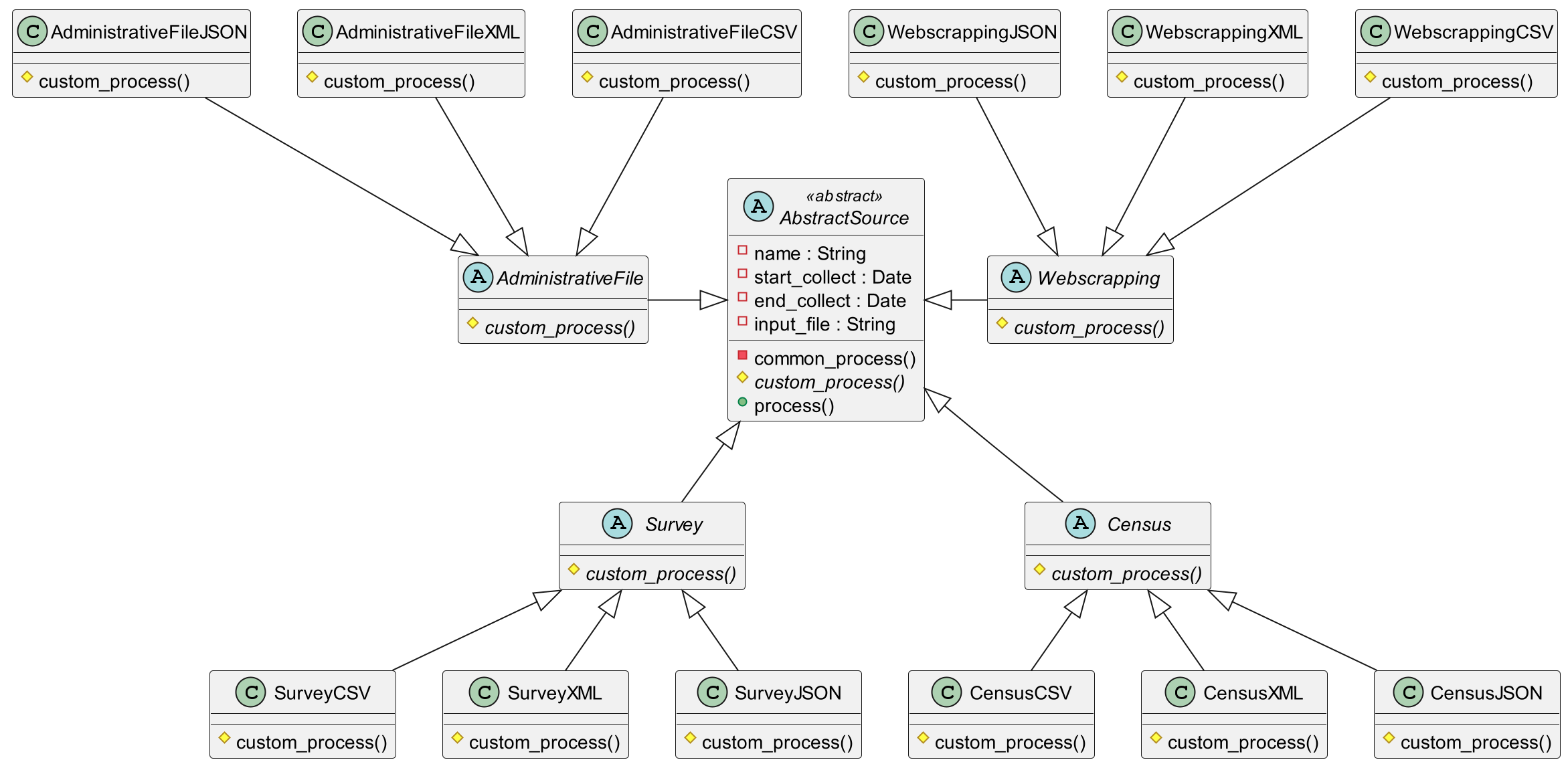
Do you see a problem?
The Power of OOP
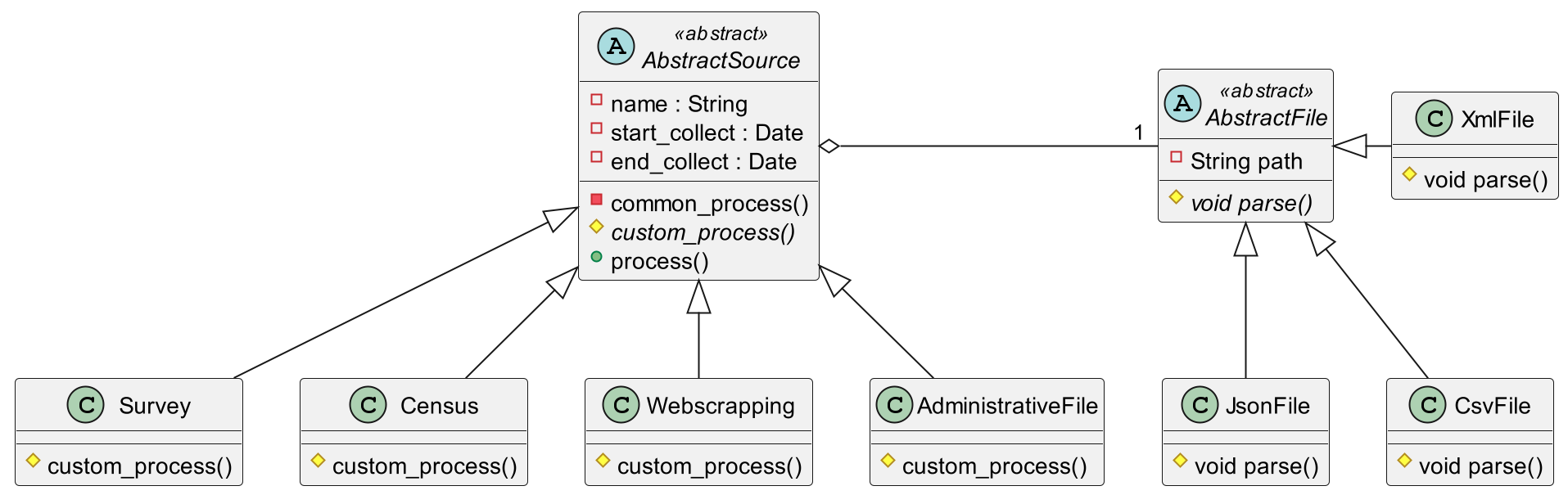
- Currently 4 * 3 “concrete” classes to define 😱
- Reading the format is dependent on the source 😵
BUT
- We can externalize this processing! 😌
- Aggregation relationship 🤯
Le bridge pattern
Work Smart, Not Hard
- Composition + inheritance: 9 classes 😎
- Inheritance: 17 classes 😫
- We can easily add types and formats 🥳
Pattern Bridge
Splitting a large class into a group of smaller classes, each with its own hierarchy, which must then be combined.
In Summary
- Use the power of OOP 💣
- Prefer specific objects (inheritance) over
if/elif/else🐱🏍 - Abstract classes are blueprints for future classes 👷♀️👷♂️
- OOP allows creating more readable, scalable, and maintainable code 👑
Software Engineering
What is Software Engineering?
- Observation: coding blindly does not result in a quality application.
- But stacking bricks blindly does not result in a house, even if you have a plan.
- Need to plan, document, test…
Why It’s Important: Parallel with Building a House
- You have the construction plan for a house (provided by the architect)
- But implementing this plan requires technical knowledge
- Need to redraw diagrams for specific areas (arches, stairs, etc.)
- This is not wasted time!
Writing quality code is like doing precision craftsmanship; it requires tools, experience, and methods.
Some Basic Principles
- Decompose a program into simple coherent modules
- Modules expose methods that can be used/overridden by other modules but remain protected from unintended modifications
- Each module should be a black box for others
- If we keep the same inputs/outputs, we can change a module without risk
- Prefer abstractions + inheritance over
if/elif/else
A Mantra
Important
Low coupling, high cohesion
- Low inter-class coupling: modifying one class should impact others as little as possible.
- High intra-class cohesion: each class should be a coherent set of attributes and methods.
Why Respect Low Coupling, High Cohesion?
- Teamwork 🦸♀️🧙♂️👨💼👩🔬
- Code readability 📖
- Debugging 🐞
Limit the risk of errors when modifying code (avoid spaghetti code) 🍝
Revisiting the Bridge Pattern
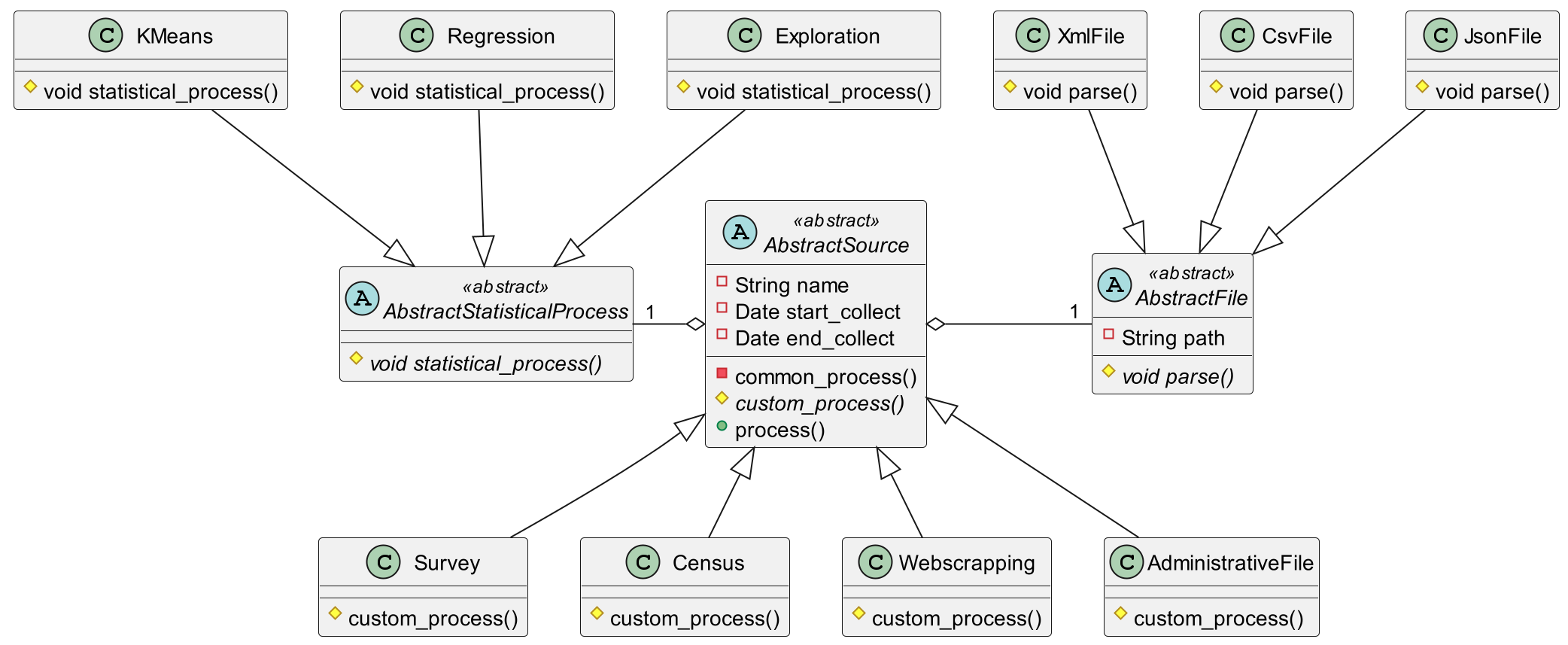
- The “Source” part handles processing related to the source.
- The “File” part handles file reading.
- Only inputs/outputs matter.
- We can add a “Processing” part for additional processing.
- No unnecessary
if/elif/else. Each part of our code handles only one thing
Every part of our code does just one thing
Design Patterns: Definition
“In computer science, and more specifically in software development, a design pattern is a characteristic arrangement of modules, recognized as a best practice in response to a software design problem. It describes a standard solution, usable in the design of different software.” — Source
Design Patterns: In a Nutshell
- Best practices
- Standard solutions to design problems
- Robust solutions
- Independent of technology
- Independent of the business
Is a tool that is there to help you
Design Patterns: Example
Recurring Problem:
- Creating complex objects that are a composition of independent characteristics
- In other words: decouple abstraction from its implementation so they can vary independently
In Summary
- Creating a complex application requires complex code 🧩
- Without a design phase, we’re heading for trouble 🧱
- There are ready-made solutions to common problems 🧰
Important
Low coupling, high cohesion